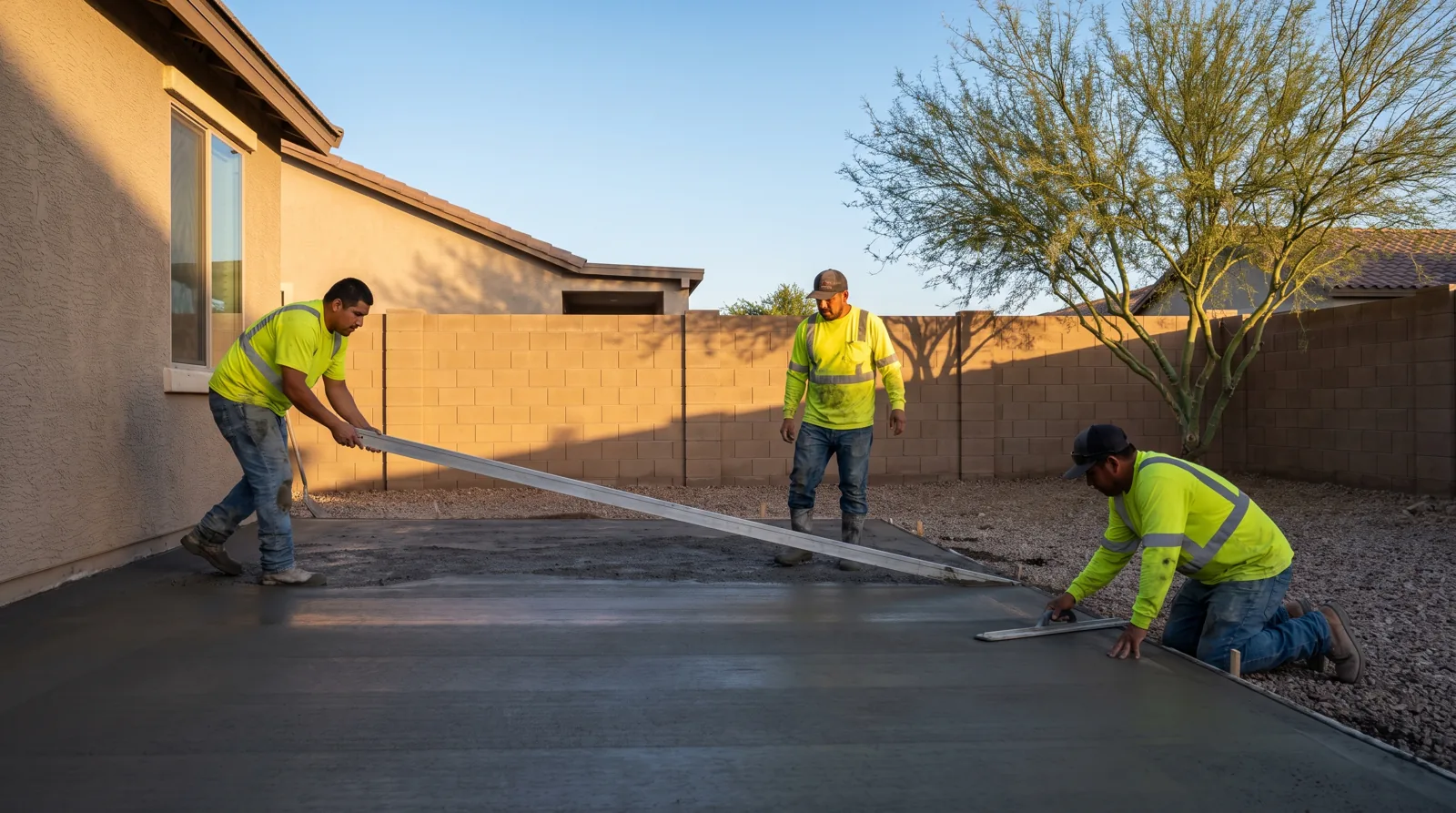
Why heat wrecks concrete
Concrete gains strength by hydrating — the cement reacting with water over days. Heat speeds the reaction and dries the surface: at 110 degrees with 8 percent humidity and a breeze, the water evaporates from the surface faster than it can rise from below, the top skins over and shrinks while the slab underneath is still soft, and you get plastic-shrinkage cracks, a weak dusting surface, and a slab that reaches maybe two-thirds of its design strength. The American Concrete Institute has a whole standard for hot-weather concreting (ACI 305), and every rule in it applies to the West Valley from May through September.
What we do differently in summer
Start in the dark. Trucks at 4 or 4:30 a.m. so the slab is placed and finished before the surface temperature climbs past 90. A summer pour that starts at 9 a.m. is already wrong.
Chilled mix. The batch plant chills the water or adds ice so the concrete arrives under 90 degrees; over 95 the mix is rejected.
Retarders and water reducers. Admixtures that slow the set and keep workability without adding water on site — adding water at the truck to make it easier to finish is the most common way a slab gets weakened.
Wet the base and forms. Dry subgrade and hot forms suck water out of the bottom of the slab; they're dampened before the pour.
Evaporation retarder. A sprayed film that holds surface moisture between floating and finishing so the top doesn't skin.
Wet cure. Once finished, the slab is kept wet — soaker hoses and burlap or plastic, or a curing compound sprayed immediately — for at least three days, seven ideally. This is the step most often skipped, and it's the one that determines final strength.
Control joints the same day. Saw-cut within hours, before the shrinkage cracks pick their own spot.
What to ask your contractor
- What time will the truck arrive in July? (Before 5 a.m.)
- Is the mix chilled, and what's the max temperature you'll accept? (Under 90–95.)
- Do you add water on site? (No.)
- How do you cure it? (Wet cure or compound, immediately.)
- When are the joints cut? (Same day.)
Can you pour in summer at all?
Yes — most of our year is summer, and slabs poured correctly in July last as long as any other. The failures come from crews that pour at 10 a.m., water the mix, and drive away without curing. A slab that's chalky, crazed with fine cracks, or dusting within a year was probably poured that way.
Common questions
Is it better to wait until fall?
Only if you want to. Correctly poured summer concrete is as strong as winter concrete; the difference is entirely in the process. October through April is more comfortable for the crew, not better for the slab.
Why does my new driveway have fine spider-web cracks?
Plastic-shrinkage cracking — the surface dried too fast during finishing. Cosmetic if shallow, a warranty issue if it's widespread, and always a sign of a hot pour done without evaporation control.
How long does concrete take to cure in the heat?
Seven days for cars and light use, 28 for full strength — the same as anywhere. Heat speeds the early set but doesn't shorten the cure.
What about pouring in winter here?
Surprise winters rarely get cold enough to matter; a frost night is handled with blankets. The main winter concern is rain on a fresh pour, which we schedule around.
Do you charge more for summer pours?
No. The early start and the chilled mix are how the job is done, not an upgrade.
Related: Driveways · Patios & slabs · Why concrete cracks · Driveway cost